 ®
®
Moving truck parking rules in Canada’s biggest cities
By MoverDash Research Team · Reviewed by Ridvan Oral, Founder & CEO, MoverDash · Last updated
Fact-checked against official sources on October 13, 2026. General information, not legal advice. MoverDash is free for customers; movers pay to reach customers who share their details.
The short answer
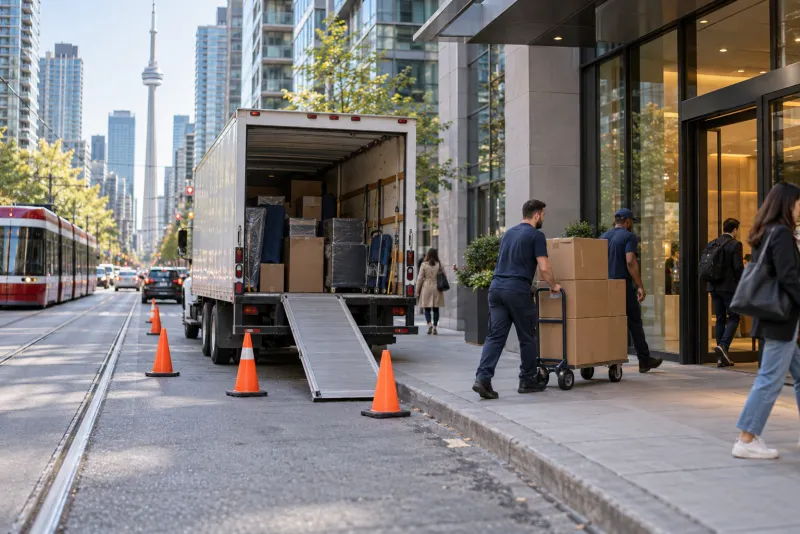
- In most cities you can park a moving truck on the street while you load, as long as you obey the posted signs. You need a permit to reserve curb space, cover meters, or leave a container on the street.
- Toronto: no permit while actively loading. A moving container on the street needs a permit: $73.89 plus HST a day, applied for in person (City of Toronto).
- Montréal: it depends on the borough. Permits range from free to at least $60.
- Vancouver and Calgary charge to reserve space. Apply at least 7 to 10 business days ahead in Vancouver and 5 in Calgary.
City by city at a glance
Every city has its own rules, and they live on different city pages. Here they are side by side, from each city’s official site. Fees are the 2026 amounts.
| City | Truck on the street | To reserve space | Container on the street |
|---|---|---|---|
| Toronto | No permit while actively loading, if signs allow | No moving permit. Temporary permits only on permit-parking streets | Permit, $73.89 + HST a day |
| Montréal | Depends on the borough | Permit, free to $60+, plus rented signs | Permit in many boroughs |
| Vancouver | Posted rules apply | Permit, $138.46 per 7 days + meters | Permit; free up to 2 days in front of your home |
| Calgary | Posted rules apply | Permit, $31.50 a day + GST | Permit |
| Ottawa | No permit if it follows parking rules | Encroachment permit, $101 + rental | Permit, $101 + at least $41 a day |
| Edmonton | Limits on trucks over 4,500 kg near homes | No moving permit published | Permit, no fee for now |
| Mississauga | Limits on vehicles of 3,000 kg or more in residential areas | No moving permit published | Road occupancy permit |
| Winnipeg | 1 hour for large vehicles | Loading permit, $2 million insurance | Use of street permit |
| Québec City | Posted rules apply | Permit for any use of the roadway, by 311 | Permit |
| Halifax | Loading allowed in No Parking zones | No moving permit published | No rule published |
Toronto
You don’t need a permit for a moving truck. The city says “moving vans are permitted to park on the street while actively loading or unloading” (City of Toronto). Drivers must still obey “posted signage”.
The sign decides where the truck can stop:
- No Parking: you may stop to load or unload.
- No Standing or No Stopping: you can’t load there. Rush-hour routes are No Stopping during the posted hours.
- No sign: parking is limited to 3 hours on city streets.
Toronto’s “special parking consideration”, a way to ask for a parking exemption, is “not available for … moving days” (City of Toronto). On a permit-parking street, you can buy a temporary permit up to 2 weeks ahead. Per space, it costs $20.74 for 24 hours, $29.97 for 48 hours or $44.94 for 7 days, plus HST (City of Toronto).
A moving container on the boulevard, sidewalk, road or lane needs a Street Occupation Permit. It costs $73.89 plus HST a day, and you must apply in person (City of Toronto).
| Offence | Fine |
|---|---|
| Stopping on a rush-hour route | $190 |
| Stopping in a bike lane | $200 |
| Parking in front of a driveway or laneway | $75 |
| Parking longer than 3 hours | $40 |
Source: City of Toronto by-law amendment, in effect August 1, 2024 (Bill 801).
Montréal
Each borough sets its own rules. Most boroughs need no permit when the street has no meters. You also have to leave parking spots, the sidewalk and bike lanes free (Ville de Montréal, French only). You need one to post no-parking signs or take over meters. In Ahuntsic-Cartierville and Saint-Laurent, if you hire a mover, the permit must be in the mover’s name.
| Borough | Cost | Apply ahead |
|---|---|---|
| Le Plateau-Mont-Royal | Free | Permit issued in the 24 hours before the occupation |
| Ville-Marie | Free | Not published |
| Outremont | Free, and always required. Signs rented extra | At least 48 hours |
| Saint-Léonard | Free, and always required | At least 24 hours |
| Côte-des-Neiges–Notre-Dame-de-Grâce | From $43, tax included | 2 business days |
| Le Sud-Ouest | From $54 | Not published |
| LaSalle | From $60, tax included. None needed for under a day | Not published |
| Rivière-des-Prairies–Pointe-aux-Trembles | From $51 plus tax | 5 business days |
Only official signs rented from a specialized company are allowed. You install them 12 to 14 hours before the move (Ville de Montréal), then tell the city’s parking agency through its online form. On a metered street, you’ll get a separate bill for covering the meters and the lost parking revenue.
Moving around July 1? Our guide to moving day in Montréal covers the dates, costs and your rights.
Vancouver
To reserve street space or meters for a moving truck, you need a temporary street occupancy permit. As of 2026, the sign fee is $138.46 for each 7-day period, plus meter rates where there are meters (City of Vancouver).
- Apply early. The city needs at least 7 to 10 business days after payment.
- The city puts up the signs 1 to 2 business days before your date. A car parked there after the signs went up can be towed.
- No insurance for residents. If you’re moving in or out as a resident, you don’t need to provide insurance. That rule is for businesses.
- A bin or container in front of your home: up to 2 days without a fee, but you still need the permit first.
Commercial loading zones and lanes next to businesses need a commercial vehicle permit to stop in.
Calgary
To hold curb space for a move, you need a street use permit and a temporary no parking permit. They cost $31.50 a day plus GST together, and paid-parking fees still apply in ParkPlus zones (City of Calgary).
- Apply online with your myID at least 5 business days ahead, or 15 downtown, on major roads or at peak hours.
- You get the signs yourself from an approved company and put them up at least 12 hours before.
- The zone counts only with signs. It’s enforceable only when the signs are up and show the approved dates and times.
Ottawa
A moving truck that follows the normal parking rules doesn’t need a permit (City of Ottawa). Anything outside those rules needs a temporary encroachment permit, and so does a portable container anywhere in the road or boulevard.
The permit costs $101, plus rental of at least $41 a day. The city needs at least 10 business days to process it. Ottawa’s temporary consideration parking permit isn’t for moves: moving companies aren’t eligible (City of Ottawa).
Edmonton, Mississauga, Winnipeg, Québec City and Halifax
- Edmonton. A vehicle over 4,500 kg can’t park next to homes (Traffic Bylaw 5590, s. 18). The exception is a commercial vehicle loading or unloading with its hazard lights on. A pod or container on a city road needs a permit. There’s no fee for now, and it takes about 6 business days (City of Edmonton).
- Mississauga. Vehicles of 3,000 kg or more can’t park, stop or stand in a residential area. A commercial vehicle on a short delivery or service stop is the exception. Street parking is banned from 2 to 6 a.m. (Traffic By-law 0555-2000). Storage containers on city property need a road occupancy permit (City of Mississauga).
- Winnipeg. A loading and unloading permit lets a truck use part of the street for a set time. It needs $2 million in liability insurance (City of Winnipeg). Large vehicles are limited to 1 hour of street parking.
- Québec City. Since December 2024, every use of the roadway needs a paid permit, ordered by calling 311. Plan up to 10 business days (Ville de Québec, French only). The page is written for construction and doesn’t mention moves.
- Halifax. You may stop in a No Parking zone while you load or unload, and a loading zone gives you 30 minutes (Halifax).
Edmonton and Mississauga don’t say whether a rental truck on a self-move counts as a commercial vehicle. Check the truck’s weight before you park it outside your home.
Plan where the truck stops
Parking is part of your moving cost. Some movers charge a “long carry” fee when the truck has to park far from the door. Some movers’ terms also make the customer pay any parking tickets during the move (MoverDash review of movers’ websites, October 2026). A week or two before moving day:
- Look at the curb at both addresses. Note the signs, meters, bike lanes, driveways and rush-hour hours.
- Ask your building about the loading dock, its height limit and the elevator. Edmonton bans loading across a sidewalk where the property has its own loading area (Traffic Bylaw 5590, s. 54).
- Decide who gets the permit, you or the mover, and put it in writing.
- Apply early. Lead times run from 24 hours in parts of Montréal to 10 business days in Ottawa and Québec City.
- Ask the mover who pays if the truck gets a ticket, and whether it charges for a long carry.
For condo moves, our condo moving page has an email to send your building about the dock, elevator and truck parking.
Questions people ask
Can I leave a moving truck on the street overnight?
Usually not. Toronto limits parking on unsigned streets to 3 hours. Mississauga bans street parking from 2 to 6 a.m., and Edmonton bars vehicles over 4,500 kg next to homes. Plan to return the truck or park it off the street.
Do I need a permit to park a rental truck?
The same street rules apply to a rental truck as to a mover’s truck. In Toronto you can load in a No Parking zone without a permit; to reserve space in Vancouver or Calgary, you need one.
Can I put up my own no-parking signs?
Not in Montréal: only official rented signs are allowed, with a permit. In Calgary, you get signs from an approved company after your permit is approved. Homemade signs aren’t enforceable.
Compare checked movers near you and decide who may contact you.
Get free quotesSources
- City of Toronto: Parking regulations · modified July 8, 2026
- City of Toronto: Temporary on-street parking permits · modified January 6, 2026
- City of Toronto: Street occupation permit · modified July 21, 2026
- City of Toronto: Bill 801, parking fine amendments · in effect August 1, 2024
- Ville de Montréal: Park a moving van or moving truck · updated June 10, 2026
- Ville de Montréal: Stationner un camion de déménagement, borough details (French only) · updated June 1, 2026
- City of Vancouver: Reserve metered spaces and street space · as of September 2026
- City of Calgary: Street use permits
- City of Ottawa: Temporary construction-related encroachments
- City of Ottawa: Temporary consideration parking permit
- City of Edmonton: Traffic Bylaw 5590 · consolidated May 12, 2025
- City of Edmonton: Bins, pods and SeaCans on city roads
- City of Mississauga: Traffic By-law 0555-2000 · June 2026
- City of Mississauga: Road occupancy permits
- City of Winnipeg: Street permits · updated December 4, 2025
- Ville de Québec: Occupations de la chaussée (French only)
- Halifax: How to avoid a parking ticket · modified April 30, 2026
All sources checked October 13, 2026.
What changed
- October 13, 2026: First published.